

For homeowners in Denver's busier neighborhoods, from LoDo to the Highlands to Cherry Creek and the busy corridors that connect them, the best windows for sound reduction combine laminated glass, dissimilar pane thicknesses, an airtight frame, and a well-executed installation. No residential window is fully soundproof, and any product marketed that way should be read carefully, but the right glass package can cut perceived outside noise dramatically, often by more than half compared to standard double-pane glass. The difference between a window rated for a quiet suburban street and one specified for an active urban corridor is significant, measurable, and something a thoughtful replacement project can target directly.
The performance is measured by the Sound Transmission Class, or STC, rating, which compares how much noise a window blocks across speech and traffic frequencies. Single-pane windows typically rate around STC 18 to 28, standard double-pane around 28 to 32, laminated double-pane configurations in the 35 to 40 range, and the highest-performing residential acoustical packages 40 and above. Each 10-point increase represents roughly a halving of perceived noise, so the jump from a basic builder window to a well-specified acoustical unit is transformative for someone living near a major street, a transit line, or a busy commercial block.
This guide walks through how Denver's neighborhood character shapes the noise question, what features actually make a window quieter, where to focus a replacement budget for the biggest impact, and how to think about the project realistically. The goal is not silence, which no window can deliver, but a meaningful reduction in the constant background noise that defines life along the city's busier streets.
How Denver's Busy Neighborhoods Shape the Noise Question
The Sound Profile of an Urban Front Range
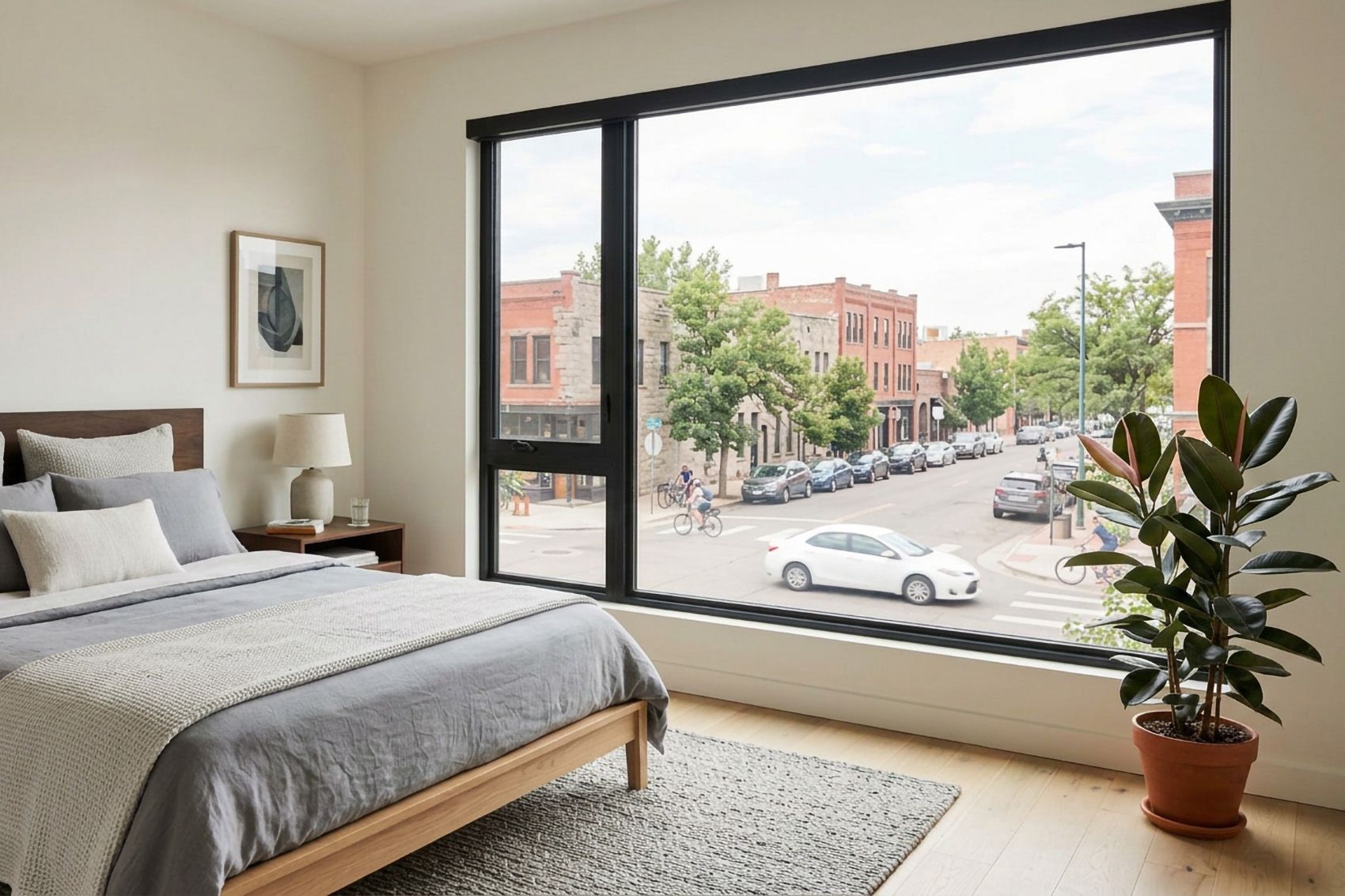
Denver's most popular neighborhoods have grown into themselves over the last decade and a half, and the development that came with that growth brought traffic, density, and constant ambient noise. LoDo and RiNo carry the steady sound of restaurants, light rail, evening crowds, and surface street traffic that runs late into the night. The Highlands and Sloan's Lake area have seen the noise that comes with becoming desirable, with more cars, more deliveries, more activity at street level. Cherry Creek, with its concentration of retail and commercial activity, sits along corridors that move serious volumes of traffic through residential blocks. Even further out, neighborhoods bordering Speer, Colorado Boulevard, Federal, and the highway corridors deal with noise levels that homeowners in quieter parts of the metro do not.
What this means practically is that the soundscape inside a Denver home varies enormously by location, and so does the value of a window upgrade. A homeowner in a quiet inner-block on a side street may notice only a modest difference from premium acoustical glass. A homeowner whose bedroom window faces a four-lane arterial may find the upgrade life-changing. Knowing where a home sits on that spectrum, and which specific rooms face the noise sources, is the starting point for any meaningful conversation about sound reduction.
Why It Matters Beyond Comfort
The case for reducing residential noise is not just about feeling more relaxed at home, though that alone is reason enough. The World Health Organization recommends bedroom noise levels below 30 decibels for good sleep quality and outdoor levels at night below 40 decibels to prevent adverse health effects from chronic exposure. Long-term research has connected sustained traffic noise to elevated stress, sleep disturbance, and a range of cardiovascular outcomes, and the European Environment Agency estimates that millions of people suffer from chronic noise-related sleep disturbance.
For Denver homeowners along busy corridors, hitting those WHO targets indoors is often difficult without higher-performance acoustical glass. Outdoor traffic noise on an active street can easily reach 65 to 75 decibels at peak times, and while a well-built standard double-pane window cuts that meaningfully, bringing interior bedroom levels down to the WHO's 30-decibel sleep threshold typically requires a window in the laminated, higher-STC range. This is where a properly specified acoustical glass package starts to do real work, not just on quality of life but on the conditions for restorative sleep.
What Actually Makes a Window Quieter
The Glass Package
The glass is where most of the sound reduction in a residential window happens, and there are four levers that matter. The first is lamination, which sandwiches a polymer interlayer between two glass plies. The interlayer absorbs sound energy and dampens the vibration of the glass itself, the same principle that makes laminated automotive windshields significantly quieter than tempered side windows. Laminated glass with a quality interlayer is the single biggest jump in residential acoustical performance.
The second is dissimilar pane thicknesses. A double-pane window with two panes of the same thickness shares a resonance frequency, a particular note at which sound passes through more easily. Using two panes of different thicknesses, for example a thinner outer pane and a thicker inner one, shifts those resonance points and breaks up the frequencies the window is most vulnerable to. The third lever is wider airspace between panes; sound waves take longer to cross a wider gap and lose more energy along the way. The fourth is the sealed insulating unit itself, with a quality gas fill like argon delivering most of its benefit on the thermal side while contributing modestly to acoustic dampening through the density of the inert gas.
The most acoustical residential glass packages combine all four: laminated outer or inner pane, dissimilar thicknesses, a generous airspace, and a quality argon-filled sealed unit. Each piece works on a different frequency range, which is why combining them produces results that any single feature on its own cannot.
The Frame and the Install
Glass is most of the story, but not all of it. A frame that allows air leakage will leak sound the same way, and a window that is otherwise excellent acoustically can be undercut by a sloppy install or a deteriorated rough opening. Quality clad-wood and fiberglass frames tend to have denser, more rigid construction than entry-level vinyl, which translates to less sound transmission through the frame itself. Tight, well-engineered weatherstripping and sash seals matter too, especially on operable windows where the seal between sash and frame is doing meaningful work.
The installation side is just as important. An expertly installed window with proper backer rod, sealant, and air sealing around the rough opening performs at or near its rated specifications; a rushed install with gaps in the perimeter sealing can lose much of the acoustical benefit the glass package was supposed to deliver. The technical details of why this works the way it does, including how sealed insulating units and gas fills contribute, are covered more fully in our guide on Double Pane Window Noise Reduction: Blocking Outside Sound Effectively, which goes deeper into the acoustic engineering than this overview can.
Targeting the Right Rooms for the Biggest Impact
Bedrooms First
For a homeowner working within a budget, the highest-value places to put acoustical glass are almost always the bedrooms. Sleep quality is where noise reduction pays back the fastest in terms of how a home feels, and the WHO targets for healthy sleep are the hardest to hit in an urban environment. Bedrooms facing busy streets, alleys with regular traffic, or noise sources like restaurants and bars deserve the strongest glass package the budget allows. The math also works in the homeowner's favor: bedrooms tend to have fewer or smaller windows than living spaces, so upgrading them is often a manageable subset of a full replacement.
Children's bedrooms and home offices follow the same logic. Both rooms benefit disproportionately from a quieter environment, whether for sleep, focus, or both. Even within a single bedroom, the window directly facing the noise source is the one that matters most; a side or rear window in the same room can usually be specified less aggressively without affecting the lived experience.
Living Spaces and the Front of the Home
After bedrooms, the next layer of priority is wherever a household spends concentrated time. Living rooms, family rooms, and kitchens that open onto busy streets benefit from acoustical glass for the same reasons bedrooms do, just on a different timetable; the noise reduction supports conversation, concentration, and the basic enjoyment of being at home. For homes with high-traffic primary living spaces facing the noisiest exposure, those windows are worth treating as seriously as bedroom windows.
For homes facing busy streets, the windows directly on the noise-facing facade typically deliver the most return per upgraded window. Side and rear elevations, with the house itself shielding them from the noise source, are usually fine with standard acoustically-compliant Energy Star Northern Climate Zone glass. A consultation that walks through which openings face which noise sources, and what the homeowner most wants to protect, is the most efficient way to scope a project.
Setting Realistic Expectations on Sound Reduction
What the Numbers Actually Mean
It helps to translate STC ratings into something a homeowner can feel. The jump from a standard double-pane window at STC 28 to a quality laminated double-pane at STC 36 represents roughly an 80 percent reduction in perceived noise; loud conversation outside drops to the level of soft conversation, and steady traffic shifts from intrusive to background. Pushing further into the STC 40 range with premium acoustical configurations gets closer to STC 45 or above, which is roughly the threshold where outside noise stops being a feature of the indoor experience for most homeowners.
Even so, the jump from STC 38 to STC 42 is far less dramatic in lived terms than the jump from 28 to 38, even though both represent four-point increases. Acoustical performance has diminishing returns at the high end, and the cost curve climbs faster than the benefit curve past a certain point. For a Denver home, the sweet spot for most exposures sits somewhere in the STC 35 to 40 range, where the noise reduction is substantial, the cost is manageable, and the marginal benefit of going higher does not always justify the marginal cost.
The Honesty Around "Soundproof"
The word soundproof, applied to residential windows, almost always overstates what the product can do. The honest measure of a window is its STC rating, not the marketing label on its packaging, and the right conversation is about how much reduction a homeowner will actually experience in the rooms they use most.
For Denver homeowners along the city's busier corridors, that distinction matters when comparing quotes. The right project is one that targets the noise-facing openings, specifies appropriate acoustical glass for those exposures, and brings the home's interior into the range where modern living, sleep, and concentration are actually possible. For a fuller view of how acoustical glass fits alongside the 2026 efficiency law, altitude, frame materials, and resale value in a Colorado window project, our Ultimate Guide to Window Replacement in Denver: 2026 Edition pulls the broader picture together.
People Also Ask About Soundproof Windows in Denver
1. Are any windows actually soundproof?
No, not in the literal sense. Even the best residential acoustical windows reduce sound rather than eliminate it. The word soundproof is widely used in marketing, but in practice it means substantial noise reduction, typically into the STC 40 range and above for the highest-performing residential products. That kind of reduction is dramatic, often dropping perceived outside noise by 80 to 90 percent compared to standard glass, but it is not silence.
For most Denver homeowners, the meaningful goal is bringing interior noise levels into a range where sleep, conversation, and concentration are not disrupted by what is happening outside. That target is achievable with quality acoustical glass; the marketing concept of total soundproofing is not.
2. How much quieter is laminated glass than standard double-pane?
The difference is noticeable and measurable. Standard double-pane windows typically rate around STC 28 to 32. Laminated double-pane windows generally land in the STC 35 to 40 range, depending on the interlayer and configuration. Since each 10-point STC increase represents roughly a halving of perceived noise, the jump from a standard window to a laminated one cuts the outside sound a homeowner actually hears by a substantial portion, often 50 to 80 percent depending on the specifics.
Most homeowners describe the difference qualitatively rather than in numbers. Steady traffic that was a clear presence becomes background hum; a passing motorcycle that was startling becomes muffled; conversations on the sidewalk are no longer intelligible from inside. Whether that level of reduction is enough depends on the home and the noise source, but for most Denver applications the laminated option is the meaningful upgrade.
3. Will triple-pane windows be quieter than double-pane?
Not necessarily. Triple-pane windows are excellent for thermal performance, but for acoustics the more important factors are lamination, dissimilar pane thicknesses, and airspace width rather than the number of panes by itself. A standard triple-pane window with three equal-thickness panes can actually perform worse acoustically than a well-designed laminated double-pane configuration, because the symmetric panes share resonance points that let certain frequencies through more easily.
The best acoustical results come from designs that combine triple-pane construction with at least one laminated pane and dissimilar thicknesses, which addresses both thermal and acoustic performance together. For a Denver homeowner specifically focused on noise, asking about the acoustical specification, not just the pane count, is the question that gets to a useful answer.
4. What kinds of outside noise are sound-reducing windows most effective against?
Acoustical glass works on the full range of common outdoor noises, but the effect is most noticeable against steady, broad-spectrum sources like traffic, transit, and general urban activity. Vehicle noise spans low-frequency engine rumble, mid-frequency tire and road sound, and higher-frequency horns and braking, and the combination of laminated glass and dissimilar pane thicknesses is specifically designed to dampen sound across that spectrum. The same construction handles the layered sound of a busy commercial block, where conversation, restaurant activity, deliveries, and overhead noise all combine into a continuous background.
Some noise sources are harder for any window to fully address. Very low-frequency rumble from heavy trucks, freight trains, or aircraft can be partially reduced but tends to require the highest-performing acoustical configurations to make a substantial difference. High-pitched intermittent sounds like sirens or motorcycles are dampened well by laminated glass but, by their nature, still register as audible events even through quality acoustical windows. For most Denver homes, the reduction across the everyday sound spectrum is what homeowners feel most, with the headline-level peaks being more about how the home muffles them than eliminating them entirely.
5. Can sound-reducing windows be added without doing a full replacement?
Sometimes, but with real limits. There are aftermarket products like interior acoustical window inserts that can be installed inside an existing window frame and add meaningful sound reduction without replacing the original window. These can be useful for renters, for historic homes where original windows are being preserved, or as a budget bridge. The downside is that they add another surface to clean and maintain, do not address the energy and compliance benefits of a true replacement, and tend to be less seamless than a properly specified replacement window.
For most homeowners with windows that are aging or due for replacement anyway, the more efficient path is a replacement that builds the acoustical glass into the new units, which also meets Colorado's 2026 Energy Star Northern Climate Zone requirement at the same time. That combined upgrade tends to be the higher-value choice when the existing windows are not worth preserving as-is.
Our Take
At Five Seasons Windows & Doors, the conversation about noise reduction is one we have often with Denver homeowners, especially those who have moved into the busier neighborhoods over the last decade as the city has grown. The technical answers are well established, the products are mature, and the difference a quality acoustical glass package makes in a home along a busy corridor is dramatic enough that customers tend to describe it as life-changing once they live with it. What we focus on in a consultation is matching the specification to the home, room by room, so the budget goes where the homeowner actually feels it.
We work with the brands we trust most for Colorado homes, Marvin, ProVia, and Anlin, each of which offers laminated glass and acoustical packages. For homeowners who want both the strongest sound reduction available and the architectural quality to match it, the Marvin Signature collection, especially the Ultimate line, brings the clad-wood frame construction and premium glazing options that are well-suited to the most demanding urban applications. The combination of dense, rigid frame construction and high-performance acoustical glass is what lets a home along a major Denver corridor feel like a quiet retreat rather than an extension of the street.
What we would tell any homeowner thinking about this is to start with the rooms that matter most and the windows facing the worst of the noise. The right project is rarely every window in the house; it is the right specification on the openings where it will make the biggest difference, paired with an installation that respects the acoustical work the glass is supposed to do. Done well, that approach delivers a noticeably quieter home without overspending on windows that face nothing but a quiet rear yard.
Final Takeaway
The best windows for sound reduction in Denver's busier neighborhoods combine laminated glass, dissimilar pane thicknesses, generous airspace, and an airtight frame installation. The right specification for a given home depends on which way it faces, where its bedrooms and primary living spaces sit, and how aggressive the surrounding noise actually is. Single-pane windows offer minimal protection, standard double-pane is a modest baseline, laminated double-pane is the meaningful upgrade for most urban applications, and premium configurations push performance further for the homes that truly need it.
The honest framing is that no residential window is soundproof, and any product marketed that way should be evaluated against what STC ratings actually mean. What good acoustical glass does provide, when matched to the home and installed correctly, is a substantial reduction in perceived outside noise, often 50 to 80 percent compared to standard glass, with the biggest gains showing up exactly where homeowners feel them most: in bedrooms, home offices, and primary living spaces along the noise-facing facade.
For Denver homeowners in LoDo, the Highlands, Cherry Creek, or along any of the city's busier corridors, the question is rarely whether quieter windows are worth it, but where to focus the budget for the biggest impact. Done thoughtfully, a sound-reduction project that targets the rooms and exposures that matter most can transform how a home feels day to day, while also meeting the state's 2026 efficiency standards in the same project. The technology is mature, the standards are clear, and the right specification for the right openings is what makes the upgrade pay off.
Get Started Today
Five Seasons Windows & Doors is Colorado’s top-rated local window company with 230+ 5-star reviews. We offer expert advice, no-pressure quotes, and flexible project options — including phased installs. Schedule your consult today.