

It can. Under the Colorado Wildfire Resiliency Code, if your home sits in a moderate or high fire intensity area and you replace 25 percent or more of its exterior wall surface, the entire exterior wall has to be brought up to the code's new-construction standards. That limits your siding choices to noncombustible materials, fire-retardant-treated wood, or ignition-resistant materials, and it also brings the first 5 feet around the house into compliance. In low fire intensity areas, and outside the mapped wildland-urban interface, a siding replacement does not trigger those wall requirements, though you will usually still need a permit.
The code is new to most homeowners. Colorado's Wildfire Resiliency Code Board adopted it on July 1, 2025, and local governments in wildland-urban interface areas with building code authority were required to adopt it as a minimum by April 1, 2026, and to begin enforcing it by July 1, 2026. Before that, wildfire rules varied widely from one county or town to the next. Now there is a statewide floor, and local jurisdictions can add stricter requirements on top of it.
This guide explains how to find out whether your home is covered, what counts as replacing 25 percent of your walls, which siding materials meet the code, and what else changes when the threshold is crossed. We also cover the questions to settle before you sign a siding contract, so the project does not stall at the permit office.
How to Know Whether the Code Applies to Your Home
The Statewide Hazard Map and Its Three Colors
The code applies to homes inside Colorado's mapped wildland-urban interface, the areas where homes meet grassland, shrubland, or forest. The state map was developed by the Colorado Division of Fire Prevention and Control and the Colorado State Forest Service, and it sorts properties into three fire intensity classifications:
- Low (yellow): Class 1 requirements apply, such as Class A roof coverings and ember-resistant vents.
- Moderate (orange): Class 2 requirements apply, which add rules for exterior walls, windows, doors, decks, and the area around the house.
- High (red): Class 2 requirements apply, the same as moderate.
For a siding project, the color is what matters most. The exterior wall requirements are part of Class 2, so they apply in orange and red areas. A home in a yellow area, or outside the mapped interface entirely, is not held to the code's wall standards when it is re-sided.
Local Adoption and Stricter Rules
The state code sets a minimum. Your city or county building department is the one that adopts it, enforces it, and decides how it applies to your address. Some jurisdictions have adopted amendments, and some may be stricter than the state baseline.
If your property spans more than one color on the map, builder guidance on the code notes that the local building department may apply the more restrictive requirements. If you believe your property's classification is wrong, the code includes a process called ground truthing, in which a qualified evaluator reviews the site and the local jurisdiction decides whether to change the classification. The simplest first step is to call your building department with your address and ask which classification applies.
What Triggers the Code During a Siding Replacement
The 25 Percent Rule
The trigger for existing homes is spelled out in Section 101.7 of the code. When "25 percent or more of the total exterior wall surface area is replaced," or when repair work "effectively replaces the exterior wall material," the code requires "the entirety of the exterior wall surface area, including attachments," to meet the requirements for new construction.
In other words, the code does not let you replace a third of your siding with the old material and leave the rest. Once the threshold is crossed, the whole house is covered. The Town of Castle Rock's guidance for existing homes puts it plainly: when work affects 25 percent or more of the total exterior wall surface, "the entire exterior wall surface (including attachments)" must be upgraded with materials specified for new construction, and that upgrade applies in moderate and high areas.
Local wording can differ. Garfield County, for example, states that in its medium and high classifications, if you replace "more than 25% of the siding, all the siding will be required to comply." Your building department's version is the one that counts.
Work That Does Not Trigger It
Not every exterior project crosses the line. Repairs that replace less than a quarter of the wall surface stay below the threshold, and the code lists painting and similar maintenance among the work that does not require compliance. Interior remodels are exempt as well.
Additions follow their own rule. The code applies to an addition when it increases the home's footprint by 500 square feet or more. A smaller bump-out stays below that threshold, though the new walls still need a permit.
Keep in mind that a permit and code compliance are different questions. Castle Rock, for example, requires an exterior wall covering permit for work affecting 25 percent or more of the wall surface in every hazard zone, including yellow. The wildfire upgrade is required only in the orange and red zones.
Siding Materials That Meet the Code
The Three Accepted Categories
In Class 2 areas, the code limits exterior wall coverings to three categories:
- Noncombustible materials, defined through ASTM E136, a laboratory test for whether a material burns
- Fire-retardant-treated wood, treated during manufacture and labeled for exterior use
- Ignition-resistant materials, which resist ignition and sustained flaming well enough to reduce losses from embers and flames
The code also allows other approaches for the wall as a whole, such as a 1-hour fire-resistance-rated wall assembly or heavy timber construction. Vinyl siding is allowed only when the wall behind it is built to one of those rated or noncombustible approaches, which is rarely practical on an existing home.
How James Hardie and LP SmartSide Fit
James Hardie fiber cement is the most straightforward fit for the noncombustible category. James Hardie states that "Hardie® siding complies with ASTM E136 as a noncombustible cladding," and that it "will not contribute fuel to a fire." Because the siding itself meets the requirement, the wall does not depend on special sheathing to comply.
LP SmartSide is engineered wood, so it does not carry a noncombustible classification. LP's approach for wildfire areas is a wall assembly: SmartSide siding paired with a fire-rated sheathing, such as LP FlameBlock, or with half-inch gypsum board behind it. Whether that assembly is accepted for your home depends on your building department. For homes outside Class 2 areas, LP SmartSide remains a strong option on its own merits.
We install both brands. In an orange or red area, the noncombustible path is usually the simpler one to permit, and that is the conversation to have before choosing a color or profile.
What Else Changes When the Threshold Is Crossed
Flashing, Trim, and Attachments
Meeting the code is not only about the siding boards. The code requires at least 6 inches of metal flashing or another noncombustible material between the sheathing and the cladding where the wall meets the ground, a deck, or a roof. Those are the places where embers tend to collect.
Trim counts too. The code allows a small exception for decorative trim and embellishments, up to 5 percent of the wall area, but that exception does not include the trim around windows and doors. Attachments to the wall, such as some decks and fences close to the house, can also fall under the requirements, so a full re-siding plan should account for everything touching the walls.
The openings deserve special attention. The siding, the trim, and the flashing around each window and door all meet at the same seam, and in a Class 2 area that seam is part of the wall the code covers. That is one more reason to plan siding, windows, and doors as one project when you can.
The First 5 Feet Around the House
Section 101.7 also ties the wall upgrade to the ground around the home. When the 25 percent threshold is crossed, "the immediate zone within 5 feet of the structure" must be brought into compliance as well.
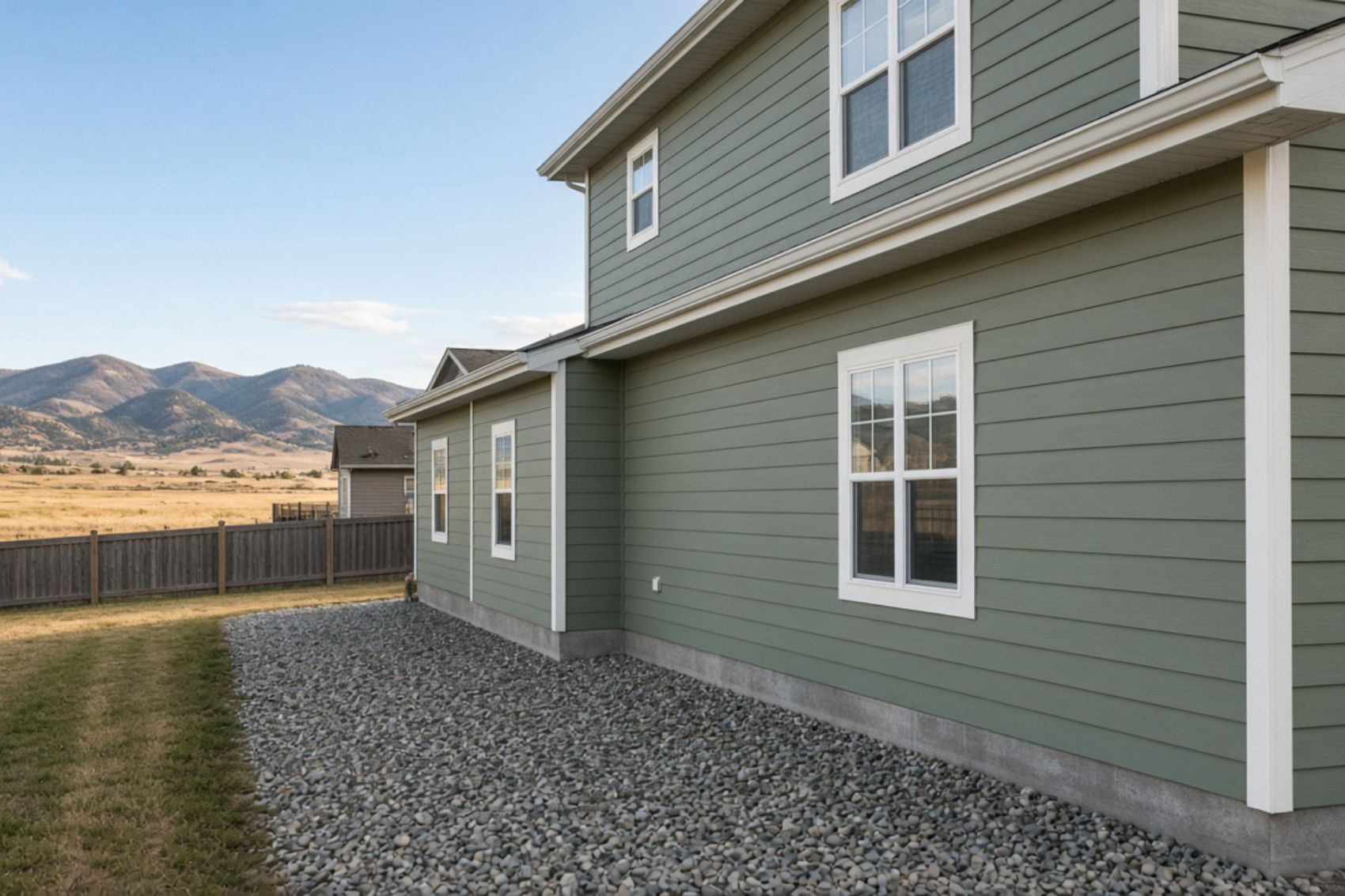
In that zone, the code calls for noncombustible, hard-surface materials "such as rock, gravel, sand, concrete." Combustible materials such as bark mulch and wood chips generally do not fit that requirement, though the code allows ignition-resistant plantings from a list approved by the local jurisdiction. For many homeowners, this landscaping work is the part of the project they did not expect, so it is worth pricing it alongside the siding.

Planning a Siding Project Under the Code
Questions to Settle Before You Sign
A few questions at the start can save weeks later. Before you sign a siding contract, get clear answers on these:
- What is my property's fire intensity classification, and has my local jurisdiction amended the state code?
- Does my project cross the 25 percent threshold, or could it stay below it?
- Which siding product, and which wall assembly if needed, will meet the requirement?
- Who handles the flashing, the trim around windows and doors, and the 5-foot zone?
- Who pulls the permit and schedules the inspection?
A contractor who works in Colorado should be able to answer each of these without guessing. If the answers are vague, ask for them in writing.
Coordinating Siding With Windows and Doors
Windows and doors have their own section of the code. In Class 2 areas, the code calls for exterior windows and glazed doors to use tempered glass, multilayered glazed panels, glass block, or glazing with a fire protection rating of at least 20 minutes. Exterior doors must be noncombustible, solid core wood at least 1 3/4 inches thick, or rated for at least 20 minutes.
Re-siding alone does not automatically trigger those window and door requirements, but the work happens at the same openings. If you are planning to replace older windows or doors in the next few years, doing them alongside the siding means the flashing, trim, and seals around each opening are built once, in the right order. If you are replacing windows at the same time, ask your building department how the window section applies to your project.
What We See in the Field
Our own reviews show how easily the seams between trades get missed. Jayme R. had a front door replaced on a project that also included basement windows and a patio door system, and the review describes what was left behind:
"They replaced the front door and left a chunk of bare wood exposed. They said since that's where siding was we would need to call out someone who does siding."
A gap like that is a finish problem anywhere. In a Class 2 area, where the code treats the whole exterior wall as one system, it is also the kind of seam that has to be built right. It is the strongest argument for planning siding, windows, and doors as one wall rather than three separate jobs, with one contractor responsible for every seam.
On a code question like this one, the useful answer is a plain one about what applies to your home, given before you commit. As John Kroeger, our Founder and President, has put it: "We focus on being honest about what we can deliver and then following through."
People Also Ask About Colorado's Wildfire Code and Siding
Do I have to replace all my siding if I replace some of it?
Only if your home is in a moderate or high fire intensity area and the work reaches the code's threshold. Under Section 101.7, replacing 25 percent or more of the total exterior wall surface area requires the entire exterior wall to meet new-construction standards. Smaller repairs stay below that line. Local wording varies, so confirm the threshold with your building department.
Does the Colorado wildfire code apply to existing homes?
For the most part, the code applies to new construction, and existing homes are not required to upgrade on their own. It reaches existing homes when certain work is done: replacing 25 percent or more of the exterior walls or roof covering, or adding 500 square feet or more of footprint. When a threshold is crossed, the affected part of the home has to meet the code.
Is vinyl siding allowed under the Colorado Wildfire Resiliency Code?
In Class 2 areas, vinyl siding is allowed only when the wall behind it is built as a 1-hour fire-resistance-rated assembly or with noncombustible construction. For most existing homes, that makes vinyl impractical in orange or red areas. In low fire intensity areas, where the wall requirements do not apply, vinyl remains an option unless your local jurisdiction has added its own rules.
Does James Hardie siding meet the Colorado wildfire code?
James Hardie states that its siding complies with ASTM E136 as a noncombustible cladding, which places it in the noncombustible category the code accepts for exterior wall coverings in Class 2 areas. Your building department makes the final call, and the rest of the wall, including flashing and trim, still has to meet the code.
How do I find my home's wildfire hazard classification?
The statewide hazard map, developed by the Colorado Division of Fire Prevention and Control and the Colorado State Forest Service, sorts properties into low (yellow), moderate (orange), and high (red). Your city or county building department can confirm the classification for your address and tell you whether local amendments apply. If you believe the classification is wrong, ask about the ground truthing process.
Related Reading
If your home is in an orange or red area, the choice of siding material matters more than it used to. Comparing the two main options side by side can help you see which one fits your home and your permit.
For a full comparison of fire ratings, hail coverage, and warranties, see our guide to James Hardie vs. LP SmartSide for Colorado homes.
Our Take
Look up your property's classification before you collect siding quotes, not after. If you are in an orange or red area and your project will cross 25 percent of the wall, plan for the whole house, the flashing, the trim around every opening, and the first 5 feet of ground, and choose a noncombustible siding so the wall complies on its own.
If you are in a yellow area or outside the interface, the code's wall requirements do not apply, and you can choose siding on looks, durability, and warranty. Either way, the permit is not optional, and a contractor who brings up the code before you ask is the one worth hiring.
Final Takeaway
Colorado's Wildfire Resiliency Code can change a siding project, but only for some homes. If your property is in a moderate or high fire intensity area and you replace 25 percent or more of the exterior wall surface, the whole wall must meet new-construction standards, including approved siding materials, noncombustible flashing at the base and roof lines, and a hard-surface zone within 5 feet of the house.
Start with your classification, confirm the local rules with your building department, and plan siding, windows, and doors together when you can. Settling those questions first keeps the project on schedule and leaves you with a home that is better prepared for wildfire season.
Five Seasons Windows and Doors is a family-owned window, door, and siding company serving the Denver metro area, Colorado Springs, Boulder, and the Front Range from its Englewood headquarters. The company holds a 4.9-star rating across more than 280 Google reviews and backs its installations with a lifetime workmanship warranty. Founder and President John Kroeger personally responds to customer feedback.
Get Started Today
Five Seasons Windows & Doors is Colorado’s top-rated local window company with 280+ 5-star reviews. We offer expert advice, no-pressure quotes, and flexible project options including phased installs. Schedule your consult today.